
I strongly believe in the Biblical proverb “to whom much is given, much is expected.”
Extraordinary wealth has been created this past quarter century, while an estimated $84 trillion wealth transfer is under way. This indicates we’re on the cusp of an entirely new era of legacy, impact, and change-making. In the same way that wealth accumulation has changed, so will the stewardship of that wealth.
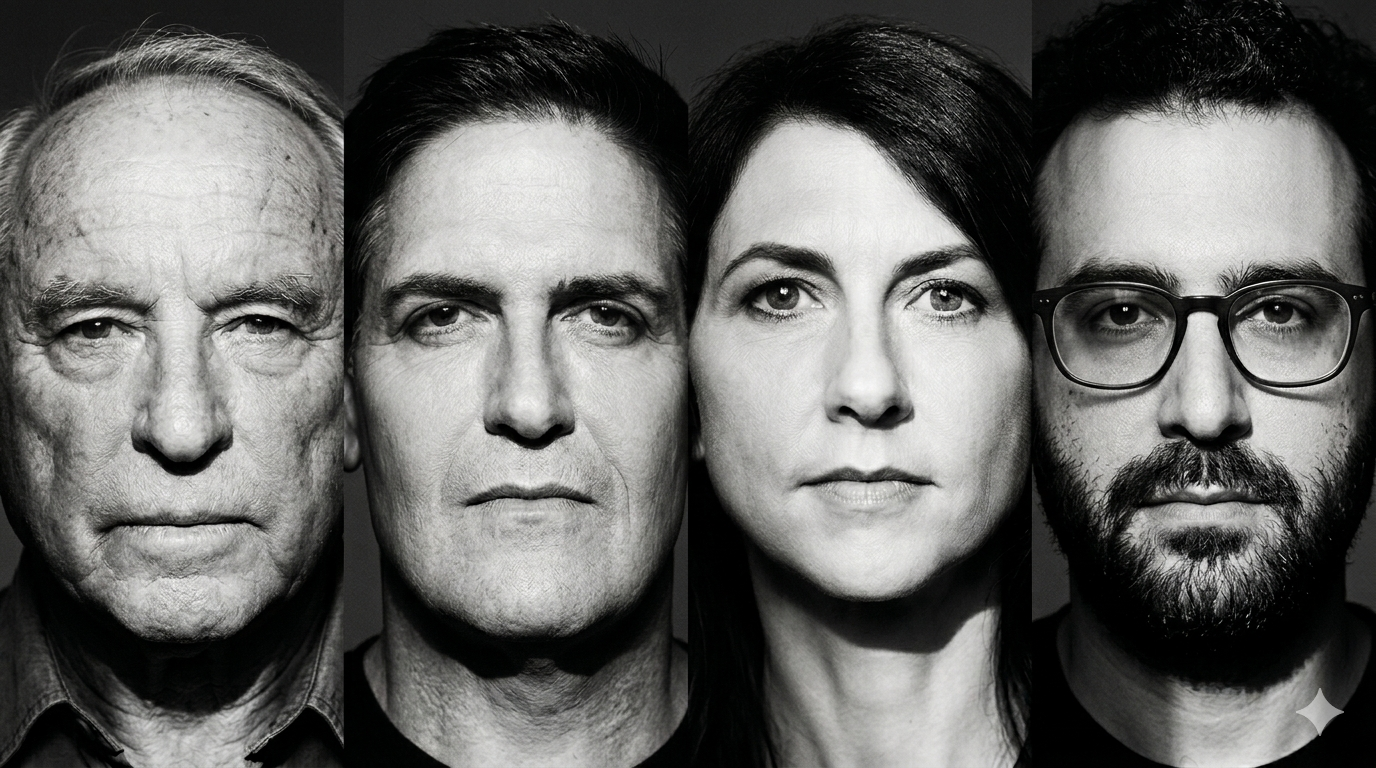
(L to R) Yvon Chouinard, Mark Cuban, MacKenzie Bezos, Dario Amodei
The visionary designer Buckminster Fuller anticipated a time when “the true business of people should be to …. think about whatever it was that they were thinking about before someone came along and told them they had to earn a living.” Today, perhaps a million people have this privilege. And responsibility.
Let’s take a look at what’s happening among multiple generations of wealth stewards, and how they present different values into the world as they realize their own consequential success?
OK, BOOMER
Giving it all away
Setting aside some questionable life choices, Bill Gates recently made a strong public statement about accelerating the pace of his philanthropy, planning to give away essentially all of his ~$200 billion over the next 20 years. Patagonia founder Yvon Chouinard, with the vast majority of his wealth, endowed innovative trusts to preserve wilderness, empowering responsible independent stewards with governance responsibility, not his direct heirs.
Generational Evolution
While the model of “make money over here, and give it away over there” exemplifies the approach of previous generations, this commitment to give it all away is a break from what we’ve seen from Rockefellers, Carnegies and others. Leading Boomers philanthropists have integrated a global awareness which was not common in prior generations.
What’s Possible
Boomers are now in their late 60s and older, and it’s unlikely to see much more innovation. Their independent and assertive nature presents an opportunity for family scions to accelerate their impact, while leaving less (although not “nothing”) to future generations. If “shirtsleeves to shirtsleeves in three generations” holds true, it may be wise to fund a legacy, inspiring future generations to build wealth on their own terms.
GEN X
Building Better Business; Women Rise
Bezos, Musk, Zuck (who is technically an older Millennial, but acts more like Xers) are behind the pace of the Boomers, and many are still actively running their primary businesses. Outliers like Steve Case and Michael Dell have embraced philanthropy, and it’s important to acknowledge the Zuckerberg Chan Initiative, Salesforce Foundation, and other tech funded philanthropy. Unlike Chouinard, these philanthropic initiatives are funded with a fraction of the wealth of their patrons, and few have reached the apex of their potential, nor their implied responsibility.
Characterized by freedom and personal responsibility, Gen Xers generally tend to innovate and create new models and businesses that solve problems. Mark Cuban carries this flag with his work on Cost Plus Drug Company, providing a real challenge to the stranglehold of traditional pharma greed. Musk and Bezos seem to believe that their work on making humans an interplanetary species is their contribution to society.
Generational Trends
This type of social entrepreneurship appears to be a reflection of the innovative and countercultural tendencies Xers have shown, and it’s possible that high-impact businesses find equal purchase with traditional philanthropy in this generation.
Extraordinary women have risen. Melinda French Gates (who at age 60, is on the cusp between Gen X and Boomer) was an equal partner until she left the Foundation, and continues to be a major philanthropist. Lorraine Powell Jobs has been an extraordinary steward of her late husband’s wealth. And MacKenzie Bezos has committed to giving away a massive amount of wealth in a short period of time. This marks a generational shift in the role women play at the forefront of impact and philanthropy.
What’s Possible
It’s possible that the biggest leverage point for change on our planet is the awakening of Silicon Valley. If this pool of tech wealth stewards ”wakes up” and embraces the consciousness and spiritual practice that has inhabited the Bay Area and progressive communities for over 50 years, a new force for evolution and well-being could still be unleashed. While there are plenty of examples of evolution towards wisdom in modest ways, I don’t yet see many founders in their 50s today making big strides towards evolved action.
DIGITAL: MILLENNIALS, AI & BITCOIN
Ethical Protocols
While a few millennial technology founders have realized generational wealth creation, for the most part, the heirs to Chouinard and Cuban have yet to step forward. Dario Amodei seems to present an early model, running Anthropic with a mindset of service and a deep philosophy of safety and responsibility. This is expressed in the core design protocol of the platform. Jack Dorsey (technically older than Zuck, but perhaps younger in spirit) exudes the values of decentralized systems, through his monk-like work on multiple crypto projects.
Anthropic’s Claude is (at least nominally) governed by a Constitution that frames how it’s supposed to act, naming values, constraints, and an ethical orientation. While it’s easy to see this as an incomplete work-in-progress, it points to an integration of values within the protocol.
The same appears to be true among Millennials designing blockchain protocols to decentralize philanthropy, and enable financial access for the less fortunate, while fundamentally changing what financial systems we can build. One promising, if nascent, evolutionary stewardship model on blockchain is the trade of ecological credits. This immature market is designed to enhance environmental conservation by tokenizing and tracking the protection and restoration of ecosystems such as forests, wetlands, and biodiversity hotspots.
In short, AI and blockchain initiatives are building the rails for the next global transaction layer, embedding stewardship inside the protocols.
Generational Trends
It may prove to be an existential question: how will the stewards of next-gen wealth exercise their deep distrust of a failing system? Historically, a wealthy person’s awareness of legacy (and responsibility) emerged in their 40s, 50s, or 60s, which indicates we’re early to make this inquiry. Paradoxically, we’re in ever accelerating cycles that suggest that this future may already be here.
More countercultural than Gen X, this generation often aligns around the erosion of capitalism and disdain for modern culture. Their values prioritize sovereignty, accessibility, and exemplify a borderless thinking that bends the brains of previous generations. Amodei expresses his values at the core of his company protocols. Bitcoin is a protocol rooted in the aftermath (or is it antidote?) of the Great Financial Crisis.
What’s Possible
If the Boomers give to charity, and Xers build their charities, will the Digital Generation transcend the need for charity? Will the digital sovereignty designers remain a radical minority, or will collapsing systems drive more people to this edge of culture?
If the model for Boomers is radical charity, and the model for Xers is social enterprise, is the model for Next-Gen the evolutionary protocol? Will the Next-Gen find a new way to create and exchange value?
It may be too soon to know.